
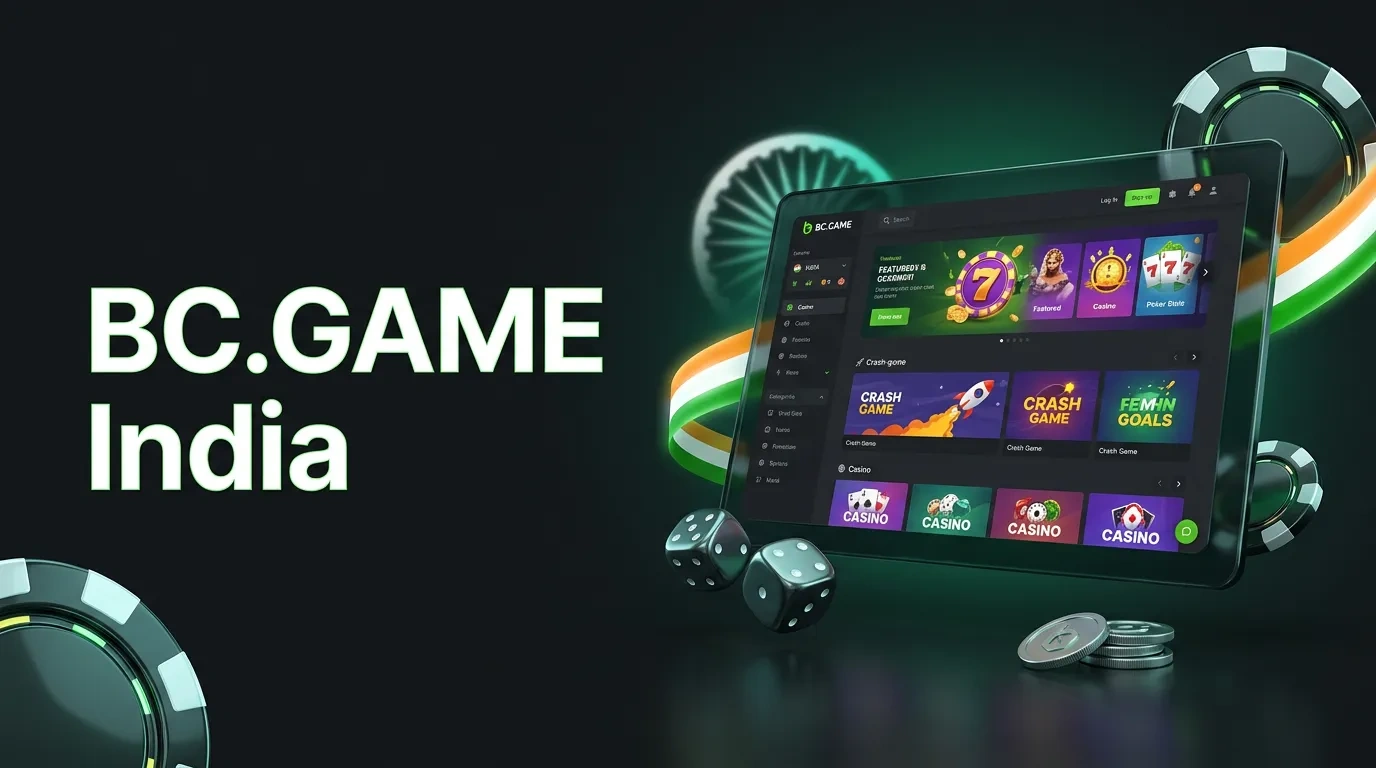
BC.GAME combines live dealer tables, slots and more than 50 Originals within a casino collection of over 3,000 games. Players in India have English and Hindi interface options, with account access through desktop and mobile browsers. The welcome package starts with a 180% match up to 20,000 BCD and continues across three further qualifying deposits. Explore the casino categories and welcome conditions to select an eligible offer. Sports, esports and racing occupy dedicated sections.
The live casino places a dealer stream alongside the game controls. A timer identifies the period available for entering selections. The table then resolves the round under its published rules and records accepted entries.
Card games, roulette and game shows use different types of decisions. The table name identifies a particular version, including its limits and additional features. A familiar game category can therefore contain several distinct formats.
The collection includes conventional tables and titles built around feature rounds. These examples show the main differences.
| Game or Table | Format | Main Interaction |
|---|---|---|
| Lightning Roulette | Roulette with additional features | Number or group selections |
| Venezia Roulette | Live roulette | Selections on the roulette layout |
| Azure Blackjack | Live card table | Decisions on the player’s hand |
| Blackjack Salon Privé | Live blackjack | Card actions under table rules |
| Crazy Coin Flip | Live game show | Selections defined by the game |
| Funky Time | Live game show | Main-round and feature outcomes |
| Lightning Dice | Dice-based live game | Selections linked to dice results |
Roulette offers individual numbers, small combinations and broader groups of outcomes. A successful single-number selection has a different payout from red or black. The table layout displays the positions available for each selection.
Standard European roulette contains 37 pockets, including zero. Standard American roulette contains 38, with both zero and double zero. This difference changes the probability of the available outcomes.
Feature versions add their own payout calculations or charges. Lightning Roulette and Red Door Roulette should be read through their individual information panels. Their additional rules form part of the cost and potential return of a round.
Blackjack compares the player’s hand with the dealer’s hand. Hitting adds another card, while standing keeps the current total. Splitting and doubling become available only under the selected table’s conditions.
The objective is to beat the dealer without exceeding 21. Stake limits and action restrictions belong to the individual table. The same opening cards can therefore present different permitted actions across blackjack versions.
Poker titles use their own hand rankings and round structures. Triple Card Poker differs from Texas Hold’em Bonus Poker, including the decisions made after the initial stake. First Person Video Poker uses a software-based presentation instead of a dealer stream.
Crazy Coin Flip, Funky Time and Lightning Storm use feature systems defined within each title. The main round can lead to an additional segment with its own payout calculation. That segment belongs to the game rather than the account’s promotional program.
A selection must receive acceptance to participate in the round. The round record identifies the result associated with that entry. For a disputed outcome, the table name and round reference provide useful details for support.
The slot catalog includes Egyptian adventures, character-based designs and traditional reel presentations. Search by title to find a known release or by provider to browse a studio’s collection. The game’s information panel supplies its payout rules and controls.
A theme describes the artwork and setting. The winning system determines how symbols produce a payout. Two games with similar visuals can still use different layouts, feature triggers and stake ranges.
Named providers help identify the exact version of a game. The following titles represent several studios within the collection.
| Slot | Provider | Notable Element |
|---|---|---|
| Fortune Tiger | PG Soft | Tiger-themed presentation |
| Le Bandit | Hacksaw Gaming | Groups of matching symbols |
| Book of Dead | Play’n GO | Book symbol and Egyptian setting |
| Ultra Wheel | PopOK Gaming | Wheel-themed reel game |
| Starburst | NetEnt | Gem-themed reels |
Le Bandit uses cluster wins rather than a conventional fixed-payline arrangement. Book of Dead uses five reels and a book symbol involved in its feature system. Its free-spin rules explain the expanding-symbol function.
Special symbols need to be read in the context of the selected title. A wild, scatter or bonus symbol can serve a different purpose from its counterpart in another game. The paytable connects those symbols with their actual effects.
Supported titles provide a demo option with virtual funds. This allows players to learn the controls and see how feature screens work. Demo balances and winnings do not become withdrawable funds.
RTP describes a theoretical return over a large volume of play. It does not forecast the result of one session or promise a percentage back from a deposit. The active game version supplies the relevant figure.
Volatility describes the distribution of outcomes. A game with larger, less frequent prizes differs from one with smaller, more frequent payouts. The description helps explain the format but cannot determine an individual result.
The Originals collection contains games developed for the brand. Crash, Limbo, Plinko, Mines and Twist use compact controls and different outcome systems. Their settings determine the available choices within each round.
Some titles settle against a decision made before the result. Others allow a cash-out during an active round. Understanding that timing is part of learning the game.
Crash shows a multiplier increasing until the round crashes. A successful cash-out settles the position at the accepted multiplier. A crash before that action loses the stake committed to the position.
Automatic cash-out settings perform the instruction selected by the player. They do not reveal the crash point. Results from earlier rounds also do not establish a dependable sequence.
Limbo begins with a target multiplier. The generated result determines whether the target’s winning condition is met. Higher targets increase the potential payout and reduce the frequency of successful outcomes.
Plinko sends a ball through pegs toward positions carrying payout multipliers. The active configuration determines the values across the board. The position reached by the ball settles the drop.
Risk settings change the distribution of possible payouts. A large multiplier at the edge of the board represents one outcome. Automatic mode repeats drops under the selected controls rather than improving their probabilities.
Mines places hidden hazards across a grid. Safe tile selections increase the available payout, while a mine ends the round with a loss. The chosen number of mines changes both the probability of a safe reveal and the payout progression.
A cash-out ends the active Mines round. Continuing introduces another tile selection. Previously revealed safe tiles do not identify the locations of the remaining hazards.
Twist uses gem outcomes with a defined payout structure. Its controls and winning arrangements appear in the game rules. The maximum prize is a ceiling under those conditions rather than an expected return.
Supported Originals include a provably fair verification function. The supplied data allows a completed result to be checked against the game’s disclosed process. This function does not predict another outcome or remove the house edge.
BC.GAME describes a welcome package with separate rewards for four qualifying deposits. Each stage assigns a match percentage and a maximum allocation. Across all stages, the package ceiling reaches 220,000 BCD.
The deposit amount determines the reward within its stage’s cap. The figures below distinguish the match rate from the largest allocation.
| Qualifying Deposit | Match Rate | Allocation Cap |
|---|---|---|
| First | 180% | 20,000 BCD |
| Second | 240% | 40,000 BCD |
| Third | 300% | 60,000 BCD |
| Fourth | 360% | 100,000 BCD |
The four percentages concern different payments. They should not be combined into one percentage applied to a single deposit. A cashier’s minimum payment also differs from a promotion’s qualifying threshold.
BCD stands for BC.GAME Dollar. It is a different denomination from Indian rupees. The numerical value of a BCD reward should not be presented as an equal INR amount.
The reward record distinguishes an allocation from credit available for use. Release conditions explain how allocated promotional funds become available. Withdrawal eligibility depends on the resulting balance and its terms.
A promotional ceiling describes the maximum allocation for a stage. It does not describe an automatic cash payment. Conversion and transfer functions depend on the balance involved.
A wagering requirement needs a calculation base alongside its multiplier. A condition based on bonus funds differs from one based on the deposit plus bonus. Eligible games and their contribution rates affect the qualifying total.
Release rules describe another part of the reward process. They should not automatically be treated as identical to turnover conditions. The active offer explains the relationship between them.
Maximum stakes, expiry dates and withdrawal conditions also belong to the selected campaign. These determine how the reward can be used and completed. The account’s promotional status provides the reference for tracking progress.
Quest Hub groups daily or weekly activities with stated completion requirements. Each task identifies its reward and participation period. Free Roll Competition uses a scoring format with ranking conditions.
Lucky Spin presents possible awards through a promotional wheel. The prizes displayed on the wheel are potential outcomes. Coin drops and chat-related activities follow their own eligibility rules.
Evolution Bet & Win involves eligible live games and leaderboard scoring. Its campaign rules determine participating tables, duration and prize distribution. A temporary leaderboard position does not establish a final reward.
Draw-based titles include Poland Keno 20/70 and UK 49s 6/49. Each uses its own number format and payout schedule. The entry record identifies the draw associated with participation.
The sportsbook organizes cricket, football, tennis and basketball by competition. Esports and horse racing have their own listings. Scheduled fixtures and ongoing events provide different routes into the available markets.
A selection concerns a defined result or scoring period. Its full label matters alongside the name of the team or player. The examples below show those distinctions.
| Category | Competition Examples | Relevant Market Detail |
|---|---|---|
| Cricket | Cricket World Cup, Big Bash League | Match or innings period |
| Football | Indian Super League, Premier League, Bundesliga | Regulation time or qualification |
| Tennis | ATP and WTA events | Match, set or game |
| Basketball | League fixtures | Full game or individual period |
| Esports | Counter-Strike 2, League of Legends, Valorant | Map or complete series |
| Racing | Royal Ascot, Melbourne Cup | Win or place conditions |
Cricket markets can concern the overall match or an event within an innings. A total needs to be read together with its specified period. The match format affects the scope of that selection.
Football selections distinguish a regulation-time result from a team qualifying after extra time or penalties. Tennis uses games and sets as separate scoring units. The market rules explain how interruptions or incomplete events affect settlement.
Live odds respond to developments during the event. A price seen during browsing can change before the selection is accepted. The confirmed bet record identifies the odds attached to the stake.
A single covers one selection. An accumulator combines several under a shared settlement structure. Adding another selection introduces another outcome requirement.
The bet slip shows the stake and potential return. That return depends on the selections meeting their settlement conditions. Void selections receive the treatment specified by the relevant rules.
The registration form offers standard sign-up and supported third-party methods. The selected route determines which details are requested. Accurate information helps connect the account with later verification and payment records.
An accessible contact channel is important for confirmation and recovery. Complete the form through the website’s registration controls.
A promotional field applies to the relevant campaign. Use a valid code only for an offer that requires one. Registration does not replace its other qualifying conditions.
The BC.GAME login method remains connected to the registration route. Third-party accounts use the associated provider. Password-based accounts use their registered credentials.
Password recovery supplies the available reset options. The registered contact channel provides access to the recovery process. Passwords and recovery codes should remain private.
Identity checks establish the connection between the profile and its holder. Requested evidence can include identification and proof of address. The designated account process identifies the documents needed.
Readable images and matching personal details help resolve the request. An incomplete submission can lead to another document request. Verification time should not be confused with the total processing period for a withdrawal.
The cashier separates adding funds from requesting a payout. INR-related methods described for the service include UPI, Paytm, AstroPay and bank transfer. Cryptocurrency examples include BTC, ETH, USDT and BNB.
Published ranges vary by method and transaction type. The active cashier provides the applicable conditions for the selected route.
| Method | Deposit Range | Withdrawal Range |
|---|---|---|
| UPI | ₹100–₹50,000 | ₹113–₹50,000 |
| Paytm | ₹200–₹50,000 | ₹113–₹20,000 |
AstroPay is listed with deposits from ₹200 to ₹100,000. Bank-transfer withdrawals are listed from ₹524 to ₹50,000. These ranges do not establish the limits for other routes or promotional deposits.
A local deposit requires the authorization requested by the payment service. The transaction reference connects the payment with its account record. Retain that reference until the transfer is resolved.
A pending transaction does not necessarily require a repeat payment. Another transfer can create a second deposit. Support can use the original reference to trace the first.
A payout request identifies the amount, destination and applicable charge. Fixed fees and percentage charges affect the amount received differently. Account checks and payment-network processing contribute separately to the total time.
The asset and network must match at both ends of a cryptocurrency transfer. A familiar ticker alone does not establish the correct route. The current cashier instructions supply the receiving address and any required memo.
Saved wallet details need to match the selected network. An incorrect route can create a transfer problem even with the intended asset. The blockchain hash provides a reference for tracing a completed transfer.
The mobile website provides routes to games, sports markets, promotions and account functions. Android and iOS users access it through a compatible browser. The existing profile connects to the same balances and transaction records.
A home-screen icon offers another entry point. A shortcut or installed web application is different from a native app. Its presence does not establish an APK download or App Store installation.
Chrome provides supported home-screen options through its browser menu. The displayed command depends on the browser and website configuration. It can create a shortcut or install a supported web application.
The browser route does not require a separate APK file. Account access still uses the registered sign-in method. A new device does not require another personal profile.
Safari includes Add to Home Screen within its Share menu. The user selects a name for the resulting website icon. Opening it provides access to the associated mobile site.
Live tables require an active connection during timed rounds. Leaving the browser can interrupt the visible stream. The game’s rules determine the handling of an interrupted session.
Live chat and [email protected] provide contact routes. The help area contains information about account functions and common issues. A specific reference helps the support team locate the relevant activity.
For a game question, include the title, table details and round identifier. For a payment question, provide the method, amount and transaction reference. Screenshots should exclude passwords and private recovery information.
A unique password helps protect the personal account. The registered email also needs protection because it supports recovery. Available security settings should be managed through the account.
A fixed spending budget keeps gambling activity separate from essential expenses. Bonus deadlines and previous losses should not determine that budget. Responsible-gambling controls provide additional ways to manage participation.